
Most teams optimize for AI search based on intuition. They publish content that feels authoritative. They guess which topics matter. They check ChatGPT responses manually and call it measurement. This isn’t a strategy. It’s hope with extra steps.
Generative engine optimization tools exist to replace guesswork with data. But most teams aren’t using them correctly, if at all.
What Intuition-Based Optimization Gets Wrong
Marketing teams accustomed to traditional SEO think they understand measurement. They track rankings, traffic, and conversions. For AI search, these metrics tell an incomplete story.
AI models don’t rank your page at position three. They either cite you or they don’t. The factors driving that decision are distributed across your entire digital footprint, not concentrated on a single page.
Teams optimizing by intuition tend to overinvest in content creation and underinvest in distribution, attribution, and competitive intelligence. They publish great articles that AI models never surface because the supporting citation network doesn’t exist.
Data-driven AI search optimization starts with measuring what actually drives citations, not what you assume drives them.
What a Data-Driven Approach Requires
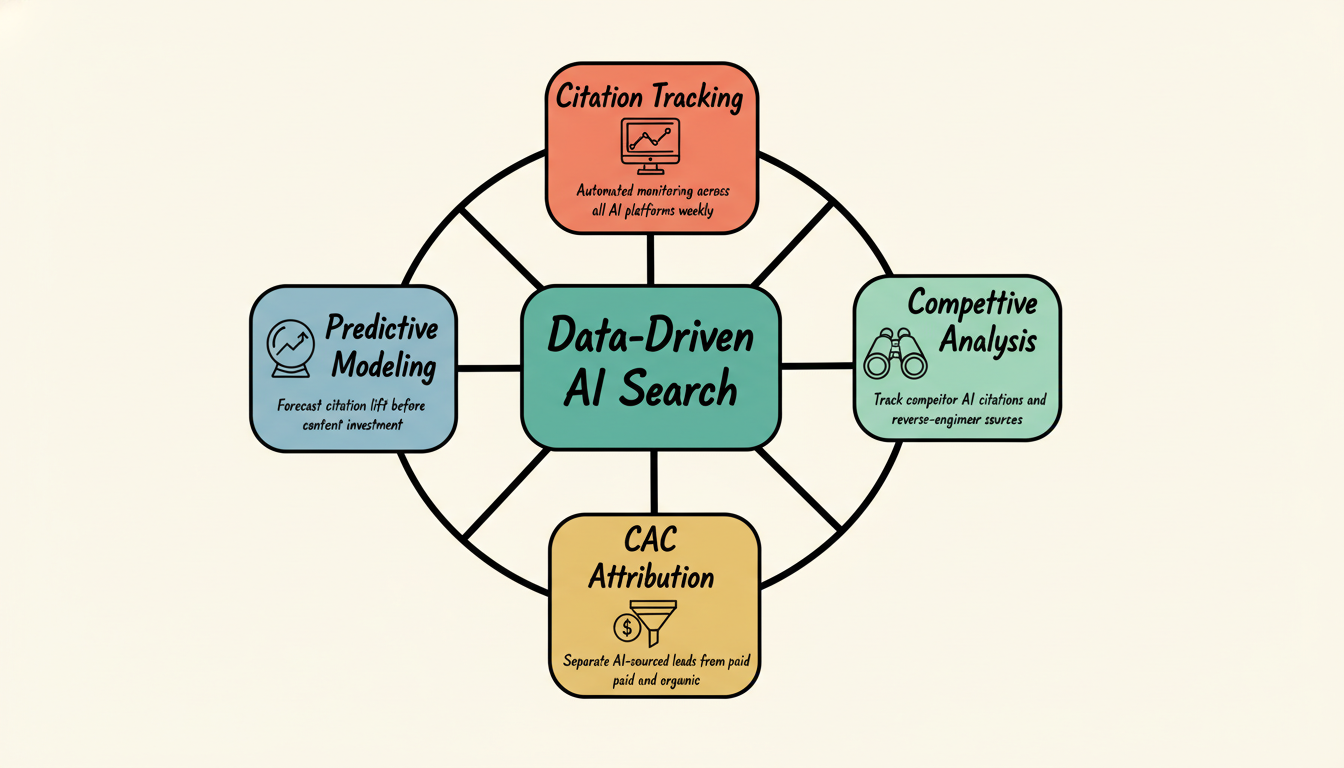
Systematic Citation Tracking
Manual spot-checks of ChatGPT responses aren’t measurement. You need automated, systematic monitoring across all major AI platforms. Track citation frequency, context, sentiment, and competitive share of voice on a weekly basis.
Generative engine optimization tools should give you a time-series view of your AI presence. Without this, you can’t identify trends, measure campaign impact, or prove ROI.
Competitive Citation Analysis
You’re not optimizing in a vacuum. Track how competitors appear in AI responses alongside you. Identify which brands get recommended for your target queries. Reverse-engineer their citation sources to understand what signals drive their AI visibility.
This competitive intelligence should inform every tactical decision you make.
CAC Attribution Across Channels
The most valuable data point is cost per acquisition by channel, including AI search. Build attribution models that separate AI-sourced leads from organic and paid. Track conversion rates for each segment independently.
This data answers the question every CFO asks: is this worth the investment?
Predictive Modeling for Content Investment
Use historical citation data to predict which content investments will yield the highest AI visibility return. Not all topics are equally citable. Not all formats perform the same. Data should drive your editorial calendar, not brainstorm sessions. Work with aeo services providers who bring proven attribution frameworks and can model expected citation lift before you invest in content production.
Building Your Measurement Stack
- Choose your AI monitoring platform. Select generative engine optimization tools that track citations across ChatGPT, Perplexity, Gemini, and Claude. Ensure they provide API access so you can integrate with your existing analytics.
- Establish baseline metrics. Measure your current AI citation rate, competitive share of voice, and citation sentiment before launching new campaigns. Without a baseline, you can’t measure improvement.
- Build cross-channel attribution. Connect your AI citation data with your CRM and analytics platform. Map the full journey from AI mention to website visit to opportunity to closed deal. Aeo services teams with analytics expertise can build this infrastructure in weeks rather than quarters, giving you actionable data fast.
- Create a reporting cadence. Report AI search metrics monthly alongside your other marketing channels. Include citation volume, sentiment trends, competitive positioning, AI-sourced pipeline, and AI-channel CAC.
- Run controlled experiments. Test specific tactics in isolation. Measure the citation impact of a guest post campaign separate from a PR push. Let data tell you which investments deliver the highest return.
Why Data Wins
Teams with data make better decisions faster. They know which campaigns drive AI citations and which don’t. They can justify budget to leadership with revenue attribution, not vanity metrics. They optimize iteratively instead of guessing.
The marketing teams still running AI search on intuition will fall behind those with measurement infrastructure. Data compounds just like citations do. Every month of measurement gives you more insight, better models, and sharper optimization.
Your competitors are building this infrastructure right now. The ones with six months of citation data will make decisions in July that your team can’t make without starting measurement today. In AI search, the data advantage is the competitive advantage. Start measuring or start losing.